


CORRUPTION RISK PREVENTION PLAN AND RELATED OFFENCES
GRANTEX-CLOTHING MANUFACTURER LTDA.
Introduction
Founded in 1987, GRANTEX-FABRICA DE CONFECÇÕES DE VESTUARIO LTDA. has been strongly committed to the ethical values of rigor, integrity and transparency, as expressed in the Code of Ethics and Conduct, since its inception.
In compliance with Decree-Law No. 109-E/2021, of December 9, which created the National Anti-Corruption Mechanism and established the General Regime for the Prevention of Corruption, GRANTEX-FABRICA DE CONFECÇÕES DE VESTUARIO LDA. has adopted a Regulatory Compliance Program, with a view to broadly preventing and repressing corruption, conflicts of interest and the various forms of lack of transparency to which it may be exposed in the exercise of its activity.
The Regulatory Compliance Program (PCN) – consisting of a Code of Conduct, the Corruption and Related Offences Risk Prevention Plan (PPR), the implementation of an internal Reporting Channel, the adoption of a training program and the designation of the Regulatory Compliance Officer (RCN) – is applicable to all our employees but also in the relationships established with partners, customers, suppliers and public entities, with a view to promoting a transversal culture of integrity and transparency.
Corruption and related offences – Forecast and legal status
The full implementation of the NCP presupposes that everyone has a minimum knowledge of the essential normative list relating to the phenomenon of corruption and related offences, which can be consulted in Annex A, without prejudice to consultation of the Penal Code and other legislation.
The Regulatory Compliance Officer
The person responsible for regulatory compliance is Lino Gomes Ribeiro, who is responsible for ensuring and monitoring compliance with the various instruments of the regulatory compliance program.
The person responsible for regulatory compliance must:
• permanently ensure and monitor compliance with the various instruments of the regulatory compliance program;
• prepare reports evaluating the implementation of the PPC;
• prepare a report for each infraction committed, which includes the identification of the rules violated, the penalty applied and the measures adopted or to be adopted
The RCN will perform its functions independently, permanently and with decision-making autonomy.
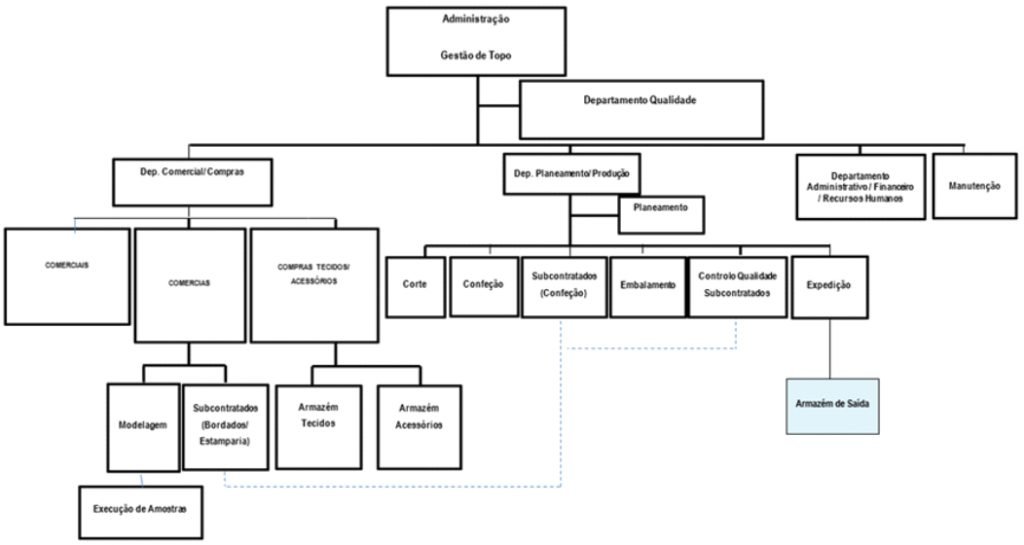
Organic structure
Methodology and risk matrix
Risk assessment inevitably contains a certain degree of subjectivity arising from in-depth knowledge of the characteristics and specificities of the organization, the procedures already in place, the environment in which it operates, the activity carried out and the degree of trust in the workers:
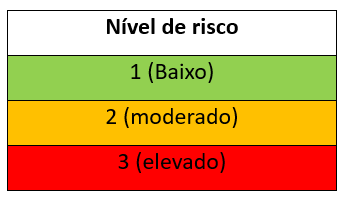
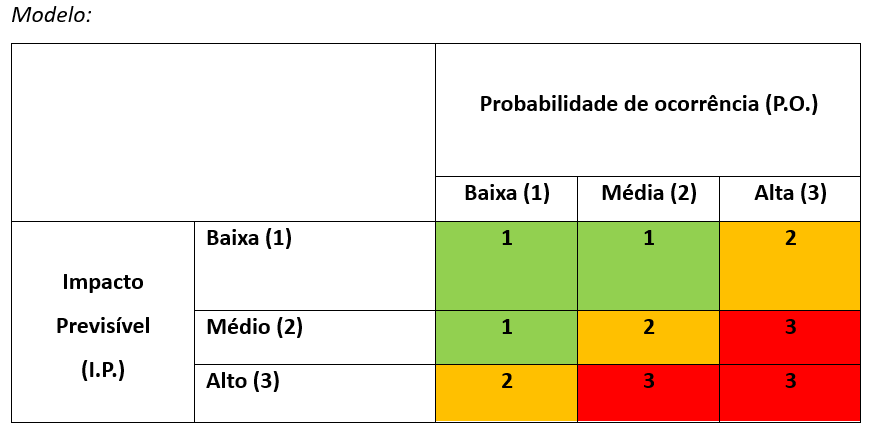
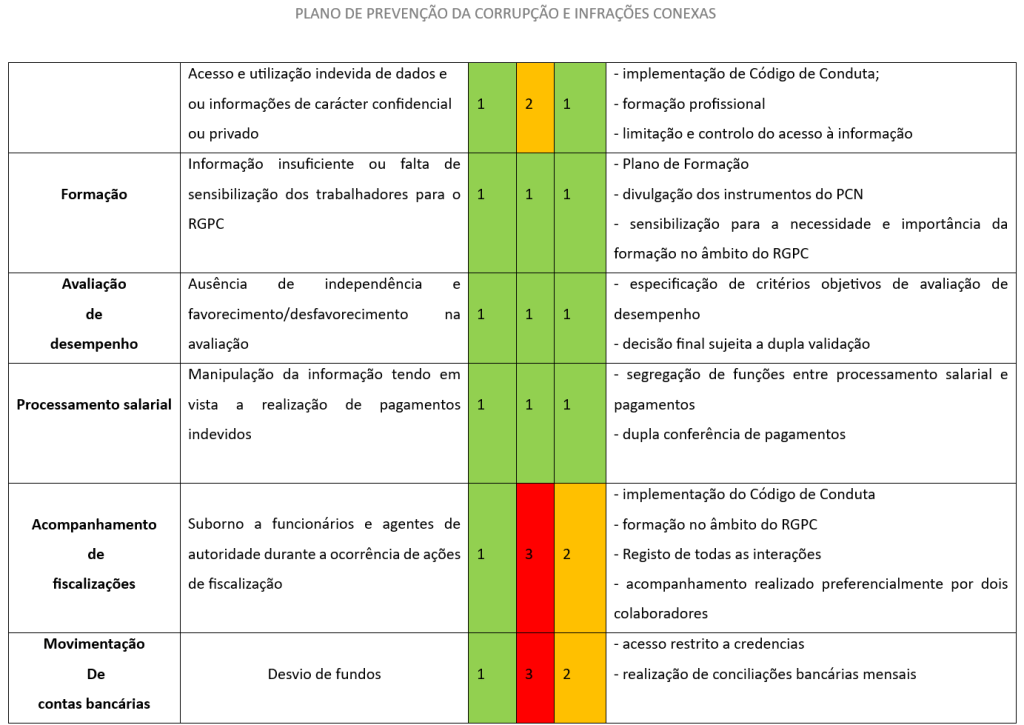
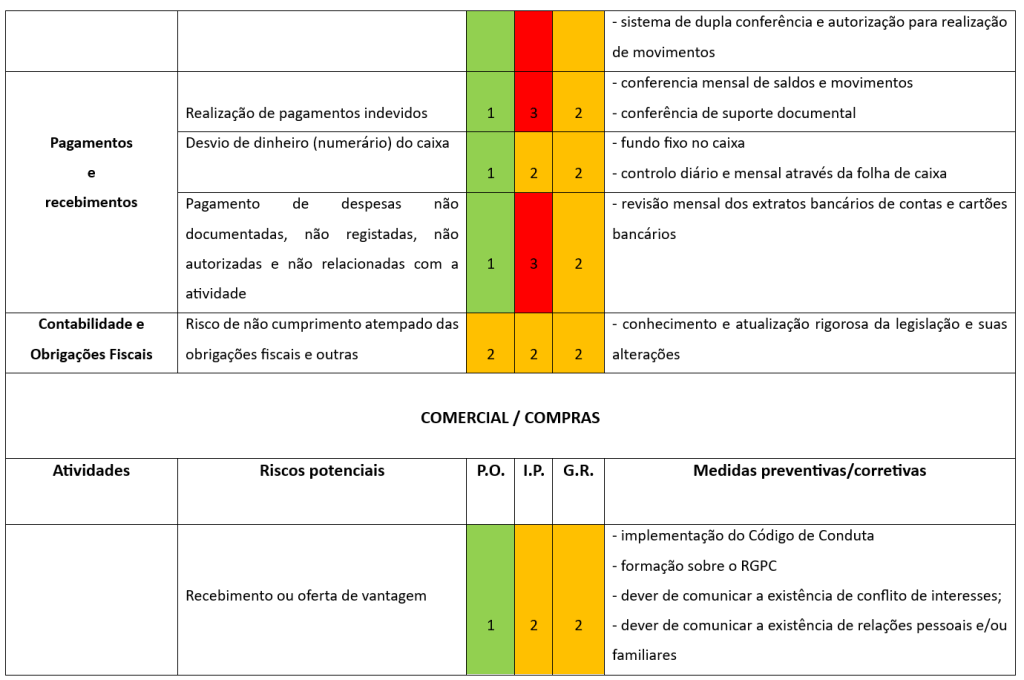
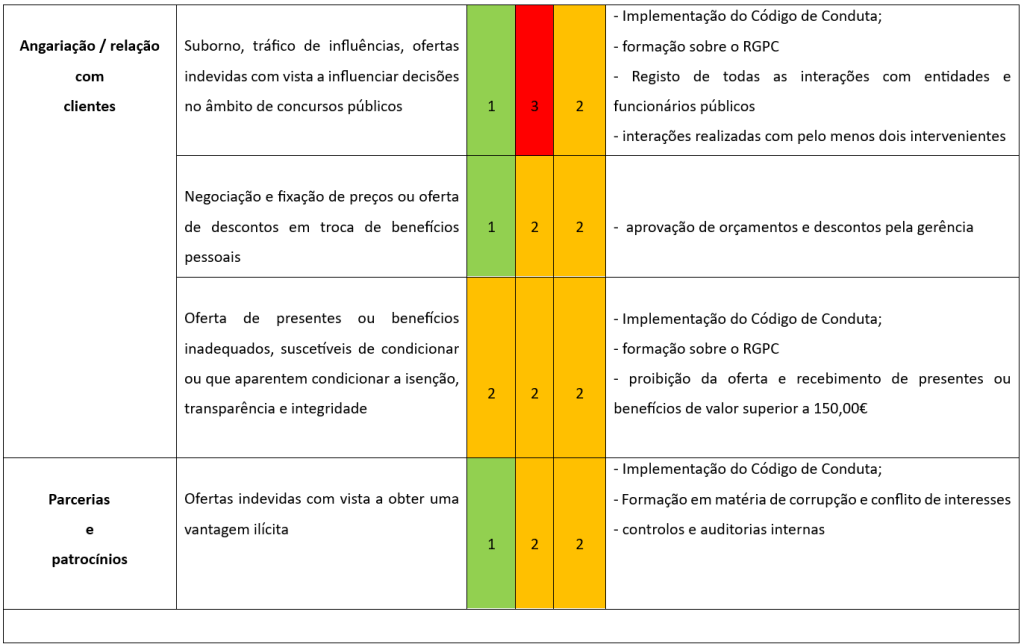
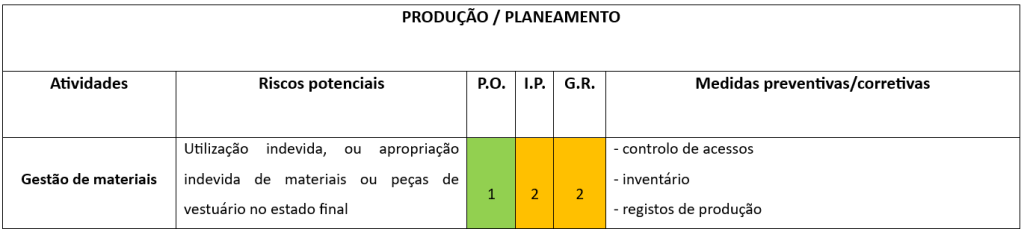
The determination of the level of risk results from the weighting of the Probability of occurrence of the risk (PO) and the foreseeable impact (IP) of the occurrence of the risk, taking into account the following factors and criteria:
Probability of risk occurrence (PO):
– Low (1): when the probability of occurrence is reduced and its prevention is ensured by compliance with preventive and/or corrective measures;
– Medium (2): When the risk may occur occasionally, and it can be mitigated by adopting preventive measures or when, despite the occurrence, the risk can be corrected and/or regularized;
– High (3): When the risk may occur regularly or when the preventive and corrective measures adopted prove ineffective;
Predictable impact of risk occurrence (IP)
–
-Low (1): Impact with effect on internal procedures, with the associated costs being insignificant
– Medium (2): Impact on the development of the activity and/or production process and/or with a medium impact on the organization’s reputation
– High (3): impact with implications at the internal level, that is, on the activity carried out and/or the production process, with significant financial costs and/or on the organization’s reputation (external level).
Risk Prevention Plan
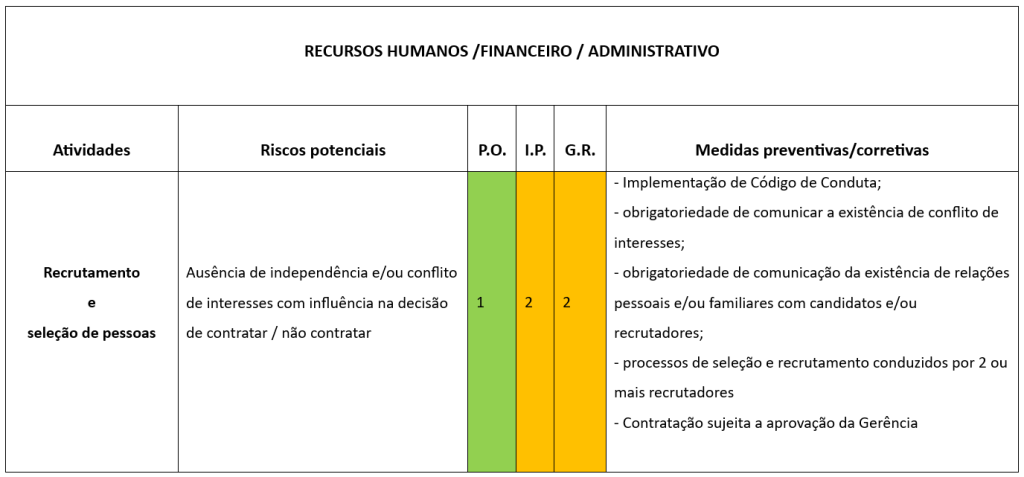
The PPR is the result of a broad analysis of the organization, which resulted in the identification of risks in each department and/or area of activity, as well as the preventive and corrective measures that we consider most appropriate to mitigate these same risks.
Monitoring
The Regulatory Compliance Officer permanently monitors the implementation and compliance with the PPC and the RGPC:
- Annually, in April, he/she will prepare an assessment report on the implementation and effectiveness of the preventive measures and risks identified in the PPR.
- Annually, in October, he/she will prepare an assessment report on the maximum risk situations.
Disclosure
The Regulatory Compliance Officer permanently monitors the implementation and compliance with the PPC and the RGPC:
Annually, in April, he/she will prepare an assessment report on the implementation and effectiveness of the preventive measures and risks identified in the PPR.
Annually, in October, he/she will prepare an assessment report on the maximum risk situations.
Disclosure
The Risk Prevention Plan and the respective assessment reports are published on the official website of GRANTEX-FABRICA DE CONFECÇÕES DE VESTUARIO LDA. on the Internet (en.php), within 10 days of its implementation and respective revisions or preparation.
Validity and Review
– This Risk Prevention Plan comes into effect after approval by the Administration, for a period of three years, without prejudice to the possibility of review before the end of the three-year period in compliance with legal standards or as determined by the RNC.
– This Risk Prevention Plan is disclosed, in its most current version, to its employees.
Prepared on 07/05/2022
1st Revision: 01/17/2025